To start a SaaS business in 2026, find a specific problem in a growing B2B niche, validate demand with pre-sales or manual workflows, build a Minimum Viable Product using modern no-code builders or AI code generators, price on value-based monthly tiers ($29 to $299/mo), and acquire your first 20 customers via targeted cold outreach and organic communities. Micro-SaaS founders can reach $10,000 in Monthly Recurring Revenue within 6 to 14 months with zero venture capital.
Building a Software as a Service company used to require half a million dollars in seed funding, six months of engineering, and a team of full-stack developers. That era is over. In 2026, solo founders and small operators are launching profitable micro-SaaS products in weeks using modular APIs, modern web frameworks, and AI coding assistants.
Software still produces the highest profit margins of any digital business model. Once your core code is live, serving 1,000 customers costs almost the same as serving 10. You build an asset that generates predictable recurring revenue and sells for 4x to 8x annual revenue when you decide to exit.
The problem is that 90% of first-time software founders build products nobody wants. They spend four months coding in isolation, launch to silence on Product Hunt, and quit. This guide breaks down the realistic, capital-efficient roadmap to start a SaaS business that customers actually pay for.
Key Takeaways
Summary at a glance
- ✓
Validate before code: Secure 5 to 10 paid pre-orders or letters of intent before writing a single line of production code. - ✓
Target micro-problems: Big horizontal tools get crushed by incumbents. Niche vertical solutions solving one painful pain point win. - ✓
Modern lean stack: Build using Next.js, Supabase, Stripe, and Claude Code, or no-code platforms like Bubble to launch in under 30 days. - ✓
B2B pricing power: Charge at least $49 to $199 per month. Cheap $9/mo consumer software causes high churn and endless support tickets.
The 4 Software Models You Can Start
Before choosing a tech stack or writing user stories, you need to pick the structural business model that matches your skills and capital.
| Model | Avg Pricing | Build Time | Capital Needed | Best For |
|---|---|---|---|---|
| Micro-SaaS | $29 – $149/mo | 2 – 4 weeks | $200 – $1,000 | Solo founders, technical freelancers |
| Vertical B2B SaaS | $199 – $999/mo | 6 – 12 weeks | $1,000 – $5,000 | Industry domain experts |
| API / Wrapper SaaS | $19 – $79/mo | 1 – 2 weeks | $100 – $500 | Fast growth experiments, marketers |
| App Store Plugin | $10 – $99/mo | 2 – 6 weeks | $200 – $1,500 | Shopify, WordPress, Jira developers |
For most beginners, Micro-SaaS or App Store Plugins offer the fastest path to profitability. Building a plugin for the Shopify App Store or WordPress ecosystem gives you built-in distribution. You do not have to generate all your traffic from scratch.
Step 1: Finding an Idea People Will Actually Pay For
Great software products do not come from late-night brainstorming sessions. They come from finding inefficient, manual business workflows that companies are already paying employees or freelancers to handle manually.
Three proven methods to find high-probability SaaS ideas in 2026:
1. The “Unbundling” Method: Look at massive platforms like Salesforce, HubSpot, or Jira. Identify one specific feature that a sub-segment of users needs, and build a lightweight, 10x simpler tool dedicated exclusively to that function.
2. The Excel Spreadsheet Replacement: Find businesses running core operations on messy Google Sheets or Excel tables. Construction estimators, property managers, dental offices, and logistics brokers often run six-figure operations on spreadsheets. Turning their manual spreadsheet formulas into a dedicated portal with user logins and automated PDF reports creates an immediate B2B SaaS product.
3. Negative Review Mining on G2 and Capterra: Search established software categories on review sites. Filter reviews by 2-star and 3-star ratings. Look for repeated complaints: “Too bloated,” “Customer support takes 4 days,” “Hidden fees,” or “Missing native integration with X.” Each recurring complaint is an open market gap.
Step 2: Validating Demand Without Writing Code
Never write code based on assumptions. Validation means getting concrete proof that people will give you money to solve their problem.
The step-by-step validation process:
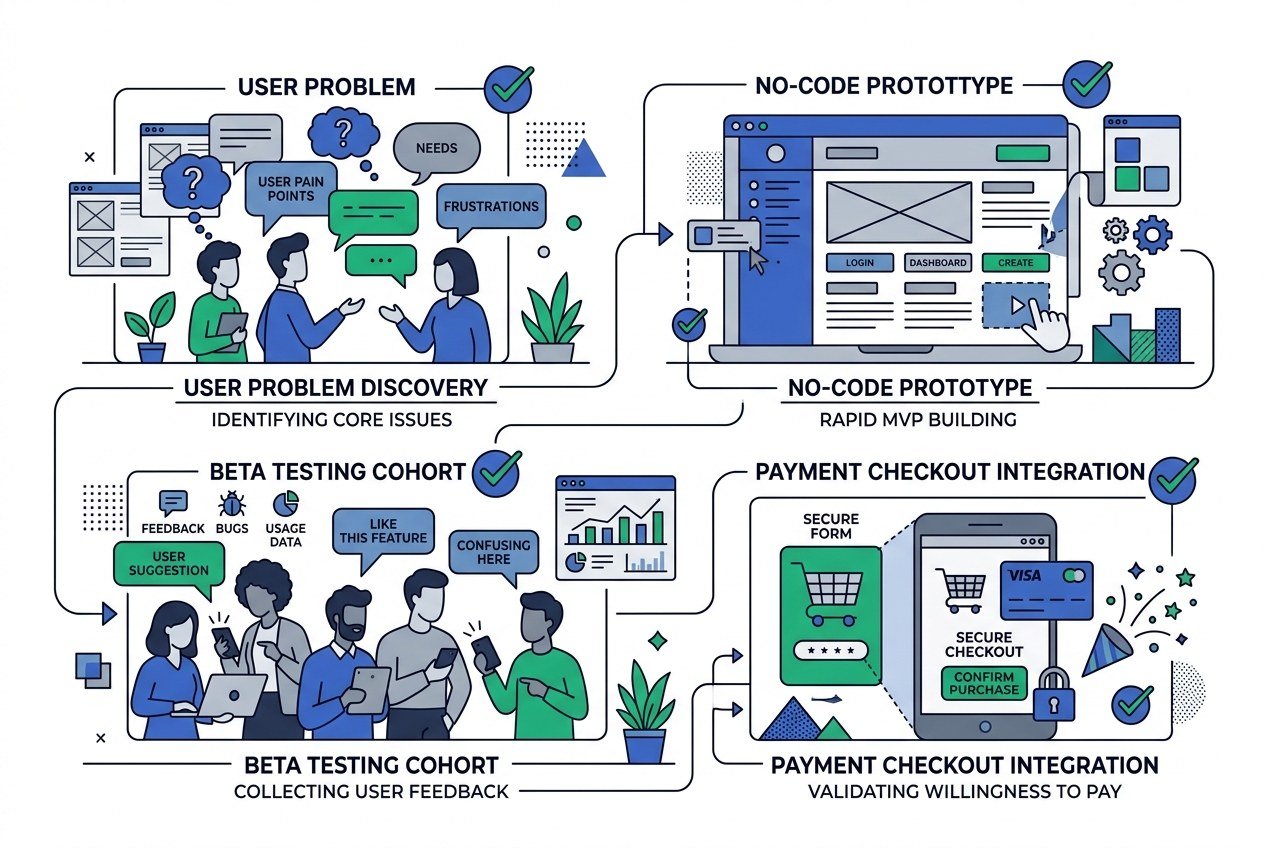
Step A: Customer Discovery Calls. Reach out to 25 people in your target demographic on LinkedIn. Do not pitch them software. Ask questions about their current workflow: “How do you currently handle X?”, “What is the most frustrating part of that process?”, and “How much does that problem cost your business each month?”
Step B: The Clickable Prototype. Design a 4-screen prototype in Figma. Show the login screen, the primary dashboard, the core action button, and the output report. Schedule follow-up calls and walk prospects through the flow.
Step C: The Pre-Sale Test. At the end of the demo, make a direct offer: “We are building the production version now for launch next month. Early access is $49/month locked in for life, compared to the $149/month public price. Would you like to reserve your spot today?” If 5 people enter their credit card via a Stripe payment link, you have validated demand. If zero people buy, iterate on the pitch or problem before touching code.
Step 3: Choosing Your Modern Tech Stack
In 2026, building software is faster than ever. You do not need to invent authentication, billing, or database management from scratch.
The Solo Developer Stack (Full Code):
- Frontend & Framework: Next.js (React) hosted on Vercel
- Database & Auth: Supabase (PostgreSQL + built-in authentication and row-level security)
- Payments: Stripe Billing or Lemon Squeezy (handles international tax compliance automatically)
- Styling: Tailwind CSS with shadcn/ui components
- AI Assistance: Claude Code or GitHub Copilot to write backend logic and API routes
The No-Code Stack (Zero Coding Required):
- Web Application Builder: Bubble or FlutterFlow
- Backend & Logic: Xano or Supabase
- Automations: Make.com or Zapier
- Landing Page: Framer or Webflow
Pick the stack you are fastest with. Customers care about whether your software fixes their problem, not what framework is running in the background.
Step 4: Setting Up Pricing and Packaging
Pricing is one of the biggest growth levers in SaaS. Most new founders charge too little, which hurts cash flow and makes customer acquisition unsustainable.
Structure your pricing into 3 clear tiers:
- Starter ($29 to $49/mo): Core features for solo users or small teams. Limited usage caps (e.g., up to 500 leads, 5 projects, or 1 user seat).
- Growth ($99 to $149/mo): Full feature access, increased limits, automated integrations, and standard email support. This should be your most popular tier.
- Scale / Agency ($299 to $499/mo): High volume limits, priority support, dedicated account assistance, and team seats.
Offer an annual discount (2 months free for upfront payment). Annual contracts provide immediate working capital to fund growth without taking debt or outside investment.
Step 5: Acquiring Your First 20 Paying Customers
Inbound SEO and content marketing take months to build momentum. For your first 20 customers, focus entirely on high-touch, unscalable direct outreach.
1. Direct LinkedIn & Cold Email Outreach: Identify decision-makers who experience the exact pain point your software solves. Send concise, value-focused messages. Offer a free 14-day trial with personal onboarding where you configure their account for them.
2. Communities and Niche Forums: Participate actively in subreddits, Discord groups, and platforms like Indie Hackers. Share honest build-in-public updates, teardowns of industry problems, and free templates that lead into your software.
3. Agency Partnerships: Many agencies need software to deliver services to their clients. If you run or partner with an agency, as outlined in our guide on how to start a digital agency, you can bundle your software into client retainers for instant distribution.
4. Directory Launches: Once your product is stable, launch on Product Hunt, Betalist, and specialized directories. While directory traffic decays quickly, it gives an initial surge of backlinks, domain authority, and early feedback.
Step 6: Tracking Key SaaS Metrics and Reducing Churn
Once you have paying customers, retention becomes more important than acquisition. High churn kills software businesses because you have to constantly replace lost revenue just to stay flat.
The 4 essential unit economics to monitor:
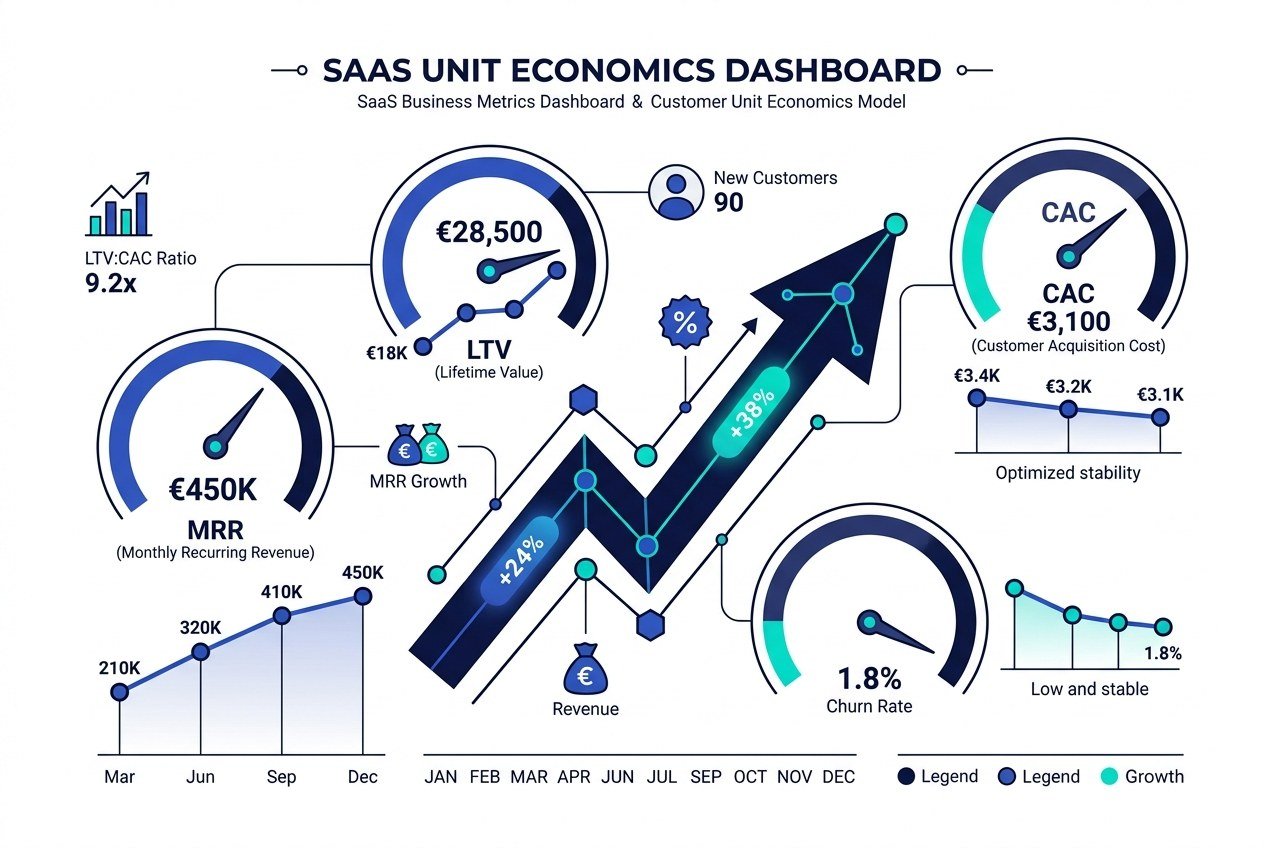
- Monthly Recurring Revenue (MRR): The total predictable subscription revenue generated every 30 days.
- User Churn Rate: The percentage of subscribers who cancel each month. A healthy B2B SaaS target is under 3% to 5% monthly churn.
- Customer Acquisition Cost (CAC): The total sales and marketing spend required to sign one new paying customer.
- Lifetime Value (LTV): The total revenue an average customer pays before canceling (Average Revenue Per User divided by Churn Rate). Aim for an LTV to CAC ratio of at least 3:1.
If churn is above 8% per month, stop marketing immediately. Survey every canceling user, fix onboarding friction, and improve core product reliability before spending more money on customer acquisition.
For more strategies on launching online income streams, explore our guide on becoming a freelance SEO consultant or browse our full Business and Make Money Online hubs.
FAQ: Starting a SaaS Business
How much does it cost to start a SaaS business in 2026?
You can launch a micro-SaaS for under $500 to $1,000. Basic costs include domain and hosting ($20 to $50), LLC formation ($50 to $200), boilerplate starter kits ($50 to $150), and subscription tools like Supabase and Stripe. Most modern infrastructure is free until you reach significant user scale.
Can you build a SaaS without coding?
Yes. Platforms like Bubble, FlutterFlow, and Webflow allow non-technical founders to build complex web applications with user databases, logic workflows, and Stripe payment processing. Many founders build their MVP on no-code, generate initial revenue, and hire developers later to rebuild on code when scaling.
How long does it take to reach $10,000 MRR?
Most successful bootstrapped SaaS founders reach $10,000 Monthly Recurring Revenue within 8 to 18 months. Achieving this milestone typically requires 100 customers paying $100 per month or 200 customers paying $50 per month, supported by consistent weekly outreach and low churn.
What is the difference between SaaS and Micro-SaaS?
A traditional SaaS aims for large addressable markets, often raises venture capital, and requires large teams. A Micro-SaaS is built by a solo founder or small team, targets a specific niche market, operates with minimal overhead, and focuses on cash flow and founder freedom rather than rapid venture-backed scale.
How do I protect my SaaS idea from being copied?
Ideas themselves have zero market value; execution and customer relationships are everything. Focus on building deep customer trust, fast feature iteration, superior customer support, and specific niche integrations. Competitors rarely copy the hard operational work required to serve customers well.
The Bottom Line
Starting a SaaS business is a marathon, not an overnight sprint. The technology to build software has never been more accessible, which means the true differentiator is your ability to understand customer pain points and execute direct sales.
Do not spend six months building a complex product in secret. Pick a narrow business problem, pre-sell 5 customers on a prototype, build the simplest version that works, and charge real money from day one.
Check the Business section on Musaholic Magazine for more weekly guides, software breakdowns, and founder case studies.