
To start a consulting business in 2026, package your career expertise into a specific high-value offer, establish an LLC, structure monthly advisory retainers between $3,000 and $10,000 per client, build credibility with 2 detailed case studies, and sign your first corporate clients through direct LinkedIn executive outreach. Solo consultants can generate $15,000 to $30,000 per month with just 3 to 5 active client retainers and zero employees.
Consulting remains the fastest vehicle to monetize high-level professional skills. Unlike agencies that deliver heavy execution or software companies that take months to build code, a consulting practice sells pure strategy, diagnostic insight, and executive decision-making.
Companies routinely pay $5,000 to $25,000 for advice that prevents costly operational mistakes or accelerates growth by six months. If you have spent 3 to 10 years working in management, engineering, marketing, finance, or operations, your existing knowledge is already worth thousands of dollars to smaller businesses struggling with problems you solved years ago.
The mistake most new consultants make is positioning themselves as generic business coaches. They try to advise anyone on anything, charge $100 per hour, and end up trading time for low wages. Here is the exact blueprint to start a high-fee consulting business in 2026.
Summary at a glance
- ✓
Sell the outcome, not hours: Price on the financial value of the solution. A project that saves a company $100,000 easily commands a $15,000 fee. - ✓
Narrow vertical focus: An Operations Consultant for B2B SaaS wins contracts over a general management consultant every time. - ✓
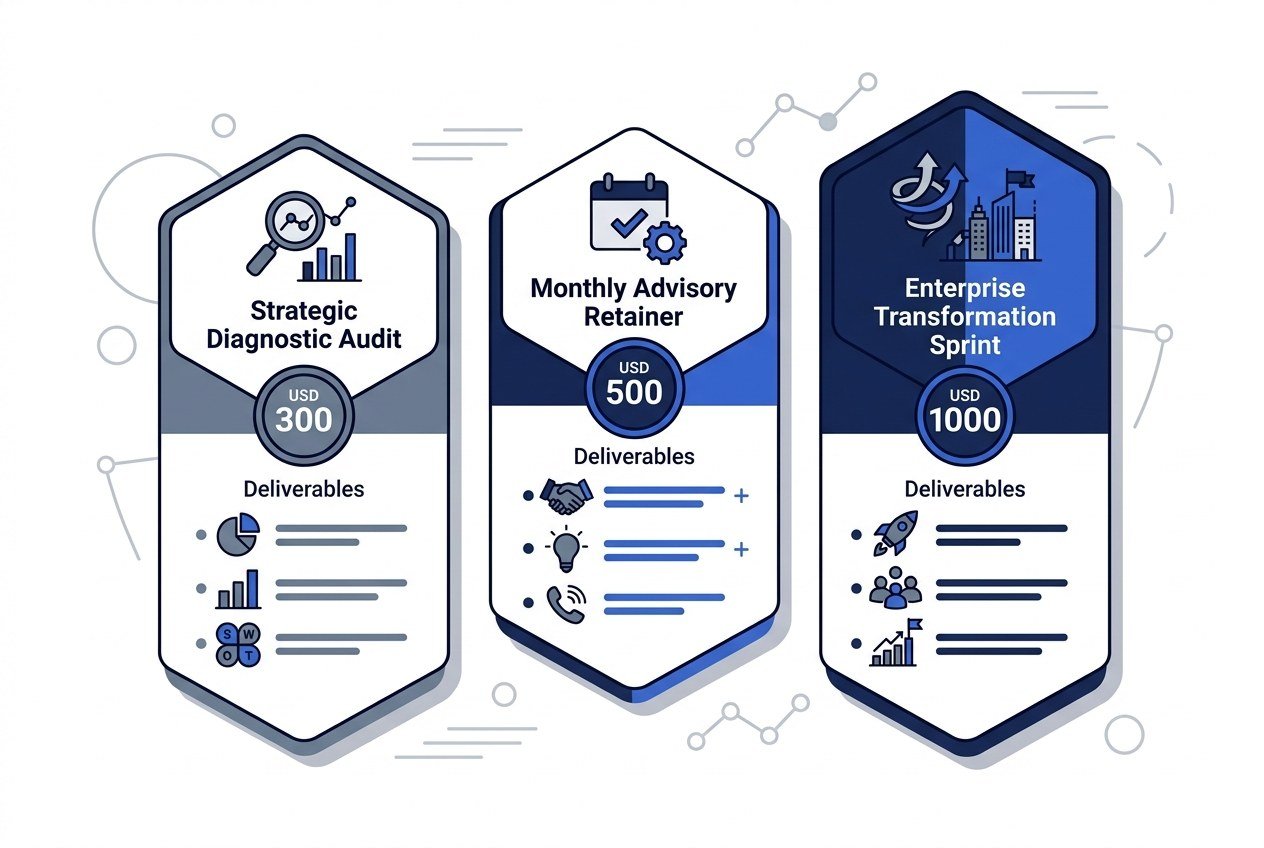
The 3-tier service model: Offer a Diagnostic Audit ($2,500), Monthly Advisory Retainer ($5,000/mo), and Strategic Sprint ($15,000). - ✓
LinkedIn outbound: Reach out directly to founders and VPs with diagnostic insights on their public operations.
The Most Profitable Consulting Niches in 2026
High corporate demand and rising technology complexity have created massive consulting budgets across four specific business verticals:
| Niche | Typical Retainer | Core Client Profile | Primary Deliverable |
|---|---|---|---|
| AI & Automation Strategy | $5,000 – $15,000/mo | Mid-market companies, law firms, logistics | Workflow automation roadmaps, AI integration |
| Fractional CMO / Growth | $4,000 – $10,000/mo | Funded startups, e-commerce brands | Customer acquisition strategy, channel audits |
| Fractional CFO / Financial Ops | $3,500 – $8,000/mo | $1M – $10M revenue SMBs | Cash flow forecasting, unit economics modeling |
| Revenue Operations (RevOps) | $4,500 – $12,000/mo | B2B tech companies, enterprise sales teams | CRM pipelines, sales funnel optimization |
Step 1: Define Your Specific Consulting Offer
Clients do not buy your background or your resume. They buy a bridge from their current painful situation to their desired future outcome.
Use the Value Proposition Formula:
“I help [Specific Target Client] solve [Specific Expensive Problem] without [Major Frustration or Risk].”
Weak Offer: “I do marketing consulting for small businesses.”
Strong Offer: “I help Series A B2B software companies cut customer acquisition costs by 35% through organic search architecture without hiring expensive in-house teams.”
When your offer is specific, prospects immediately know if it applies to them, and price resistance drops by half.
Step 2: Legal Setup and Business Infrastructure
A professional consulting practice requires clean corporate plumbing before pitching executives.
1. Corporate Entity: Form a Single-Member LLC in your home state. This shields your personal assets from business liabilities. Use LegalZoom or file directly through your state portal for $100 to $300.
2. Business Banking & Payments: Open a dedicated business checking account on Mercury or Relay. Use Stripe or Wise Business to bill international clients with zero friction.
3. Consulting Agreement Template: Download a Master Consulting Services Agreement from Bonsai. Ensure it includes an explicit Non-Disclosure Agreement (NDA), intellectual property transfer upon final payment, net-15 payment terms, and a 30-day cancellation clause.
4. Executive Tech Stack: Equip your practice with AI tools for freelancers and consultants, including Otter.ai for automatic meeting recaps, Perplexity Pro for deep market research, and Notion for client deliverables.
Step 3: Creating Your 3-Tier Consulting Menu
Give prospects choices in how they work with you. A 3-tier menu allows prospects with different budget levels to say yes.
- Tier 1 — Strategic Diagnostic Audit ($2,500 to $5,000 one-time): A 2-week deep evaluation of the client’s systems, data, or marketing pipeline. Deliverable: a 15-page diagnostic report with prioritized recommendations. This is your foot in the door.
- Tier 2 — Monthly Advisory Retainer ($4,000 to $8,000/month): Bi-weekly 60-minute strategy calls, ongoing Slack access for executive questions, and strategic review of deliverables produced by their internal team.
- Tier 3 — Intensive Transformation Sprint ($12,000 to $25,000 project): A 60-day hands-on engagement where you design and oversee the complete overhaul of a key business function.
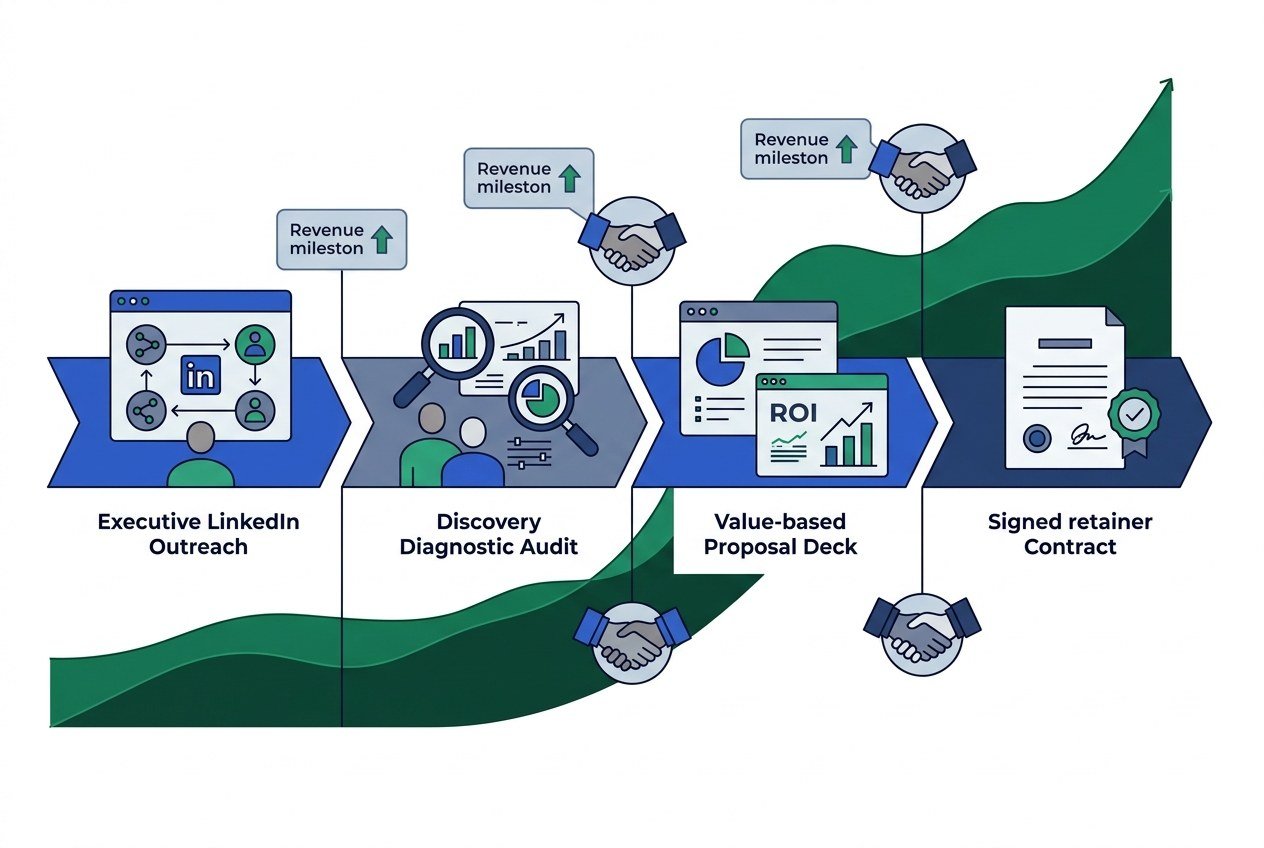
Over 60% of clients who purchase your Tier 1 Diagnostic Audit naturally convert into Tier 2 Monthly Retainer clients to help them execute the roadmap you created.
Step 4: Landing Your First 3 Corporate Clients
Do not run Facebook ads or waste months posting motivational quotes on social media. High-ticket consulting clients are acquired through high-touch outbound networking.
1. The Warm Network Reactivation: Send personal emails to 30 former managers, clients, and colleagues. Tell them: “I have launched an independent advisory practice focusing on [niche problem]. I am taking on 2 pilot clients this quarter at a discounted rate to build initial case studies. Do you know of any companies currently dealing with [problem]?”
2. Direct LinkedIn Executive Outreach: Use LinkedIn Sales Navigator to filter for founders, CEOs, and VPs at companies with 20 to 200 employees. Look for trigger events: new funding rounds, executive departures, or aggressive hiring.
Send a value-first connection message: “Hi Mark, noticed your team recently launched [New Product Line]. I put together a 3-minute video breakdown of two conversion bottlenecks on the new landing flow that might be costing you signups. Would it be helpful if I shared the link here?”
This approach has a 35% response rate because it demonstrates value before asking for a single dollar.
Step 5: Scaling from Solo Consultant to Advisory Firm
Once you reach 5 clients paying $5,000/month ($25,000/month total), your calendar will be at capacity. To grow further, you have two distinct paths:
A — Increase Retainer Rates: Raise your prices to $10,000/month per client and reduce your roster to 3 high-impact corporate accounts ($30,000/mo) with maximum personal freedom.
B — Agency Transition: Hire junior specialists to execute deliverables while you remain the lead strategist, as detailed in our guide on how to start a digital agency.
C — Productized Software: Transform your proprietary consulting diagnostic frameworks into software tools, following our blueprint to start a SaaS business.
If you are exploring consulting as a specialized side venture, review our guide on how to become a freelance SEO consultant or browse our full Business category.
FAQ: Starting a Consulting Business
How much experience do you need to start consulting?
You do not need 20 years of experience. You only need to know more about a specific business process than the executive hiring you. 3 to 5 years of hands-on experience in a specialized domain (like paid ads, cloud migration, B2B sales, or hiring) is more than enough to advise early-stage businesses and SMBs.
How do consultants set their prices?
Consultants price based on value, not costs. If your strategic advice helps a company increase sales by $200,000 or avoid a $50,000 bad software hire, charging a $10,000 advisory fee is an obvious return on investment. Anchor your pricing to the financial scale of the client’s business.
Do I need an MBA or professional consulting certification?
No. Corporate clients hire independent consultants for practical results, domain knowledge, and agility, not academic credentials. Real case studies, clear diagnostic frameworks, and client testimonials carry 10x more weight than a business degree.
How many hours a week does a consultant work?
A solo consultant managing 4 retainer clients typically works 20 to 30 hours per week. This includes 8 hours of direct client strategy calls, 10 hours of research and document review, and 5 to 10 hours of business development and marketing.
What is the difference between consulting and freelancing?
Freelancers sell their time to execute tasks (writing articles, designing logos, coding features). Consultants sell high-level strategic direction, diagnostic audits, and decisions (telling companies which features to build, how to position products, or how to fix operational bottlenecks).
The Bottom Line
Starting a consulting business is the highest-margin way to monetize your existing professional skills in 2026. You do not need employees, venture capital, or complex software stacks to build a $20,000 per month practice.
Pick a specific business problem, define a clear diagnostic offer, package it into a monthly retainer, and reach out to 30 decision-makers on LinkedIn this week.
Check the Business hub on Musaholic Magazine for more founder interviews, high-ticket sales strategies, and executive blueprints.