
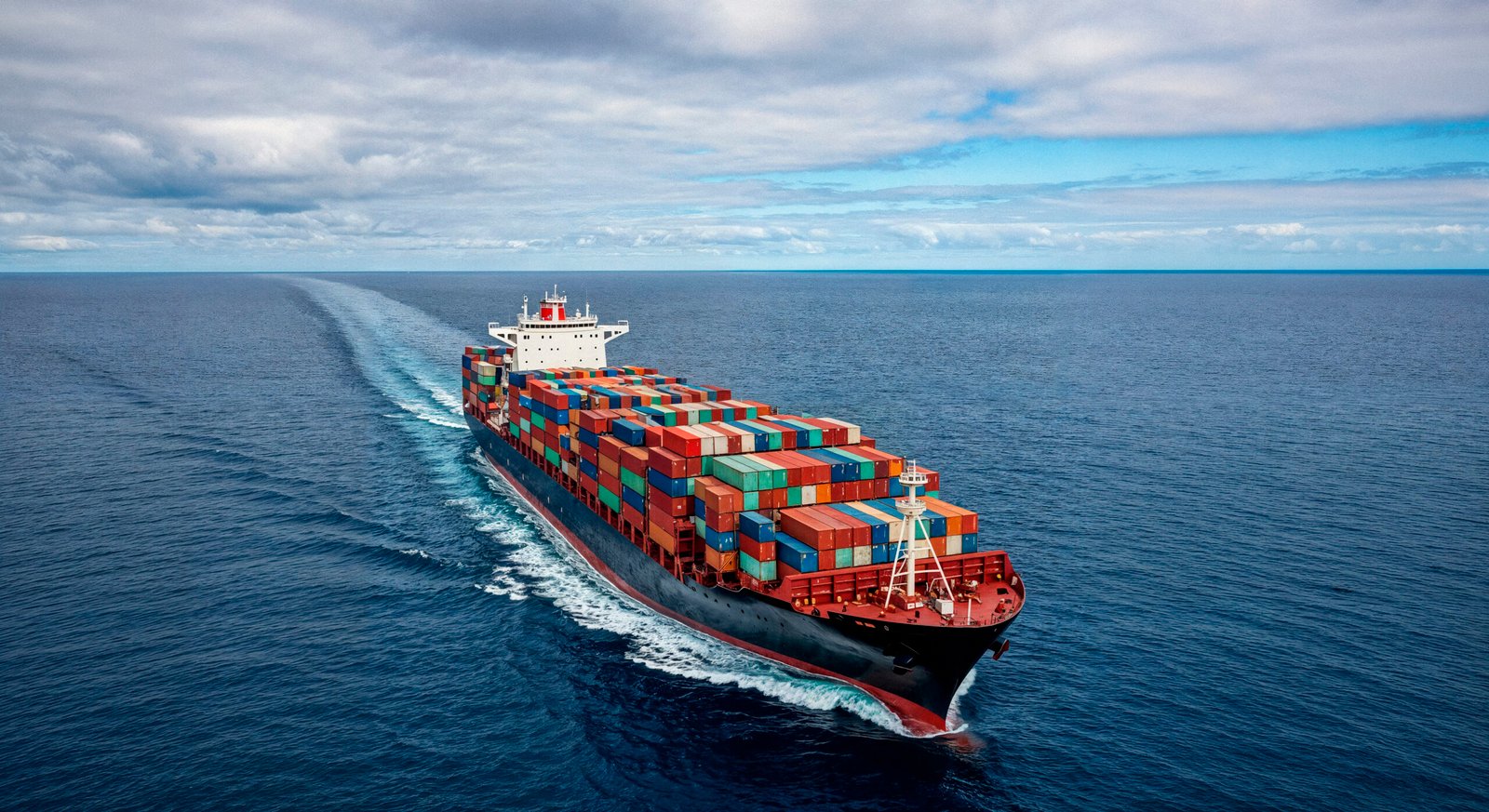
Container ships have doubled in size over the past two decades, but one thing hasn’t changed: the ocean remains unforgiving. When a vessel with the length of four football fields hits a weather front, every unsecured pallet and every poorly balanced container becomes a physics problem with real-world consequences. That’s why cargo securing and cargo packing are no longer just technical routines but operational risk factors that affect insurance costs, customer satisfaction, and the credibility of the carrier.
Industry audits show that a significant portion of container weights remain inaccurately declared, which makes even well-prepared stowage plans behave unpredictably at sea. Misreporting a few hundred tons across a single bay can cause the vessel’s rolling response to deviate more than the crew anticipates. That small deviation is often where accidents begin.
Tip: For a deeper breakdown of what safe cargo stowage involves from a maritime safety perspective, you can find a practical overview here.
Why the IMO’s Framework Matters More Than Ever
The International Maritime Organization (IMO) may issue standards, but those standards are built on decades of casualty reports, structural analysis, and lessons learned. The CSS Code and SOLAS are not bureaucratic paperwork; they are pattern recognition at a global scale.
Experienced operators tend to internalize a few nuances:
- The Cargo Securing Manual (CSM) is vessel specific. A plan written for one ship class rarely fits another.
- Most failures start inside the CTU. Incorrect internal cargo packing often causes shifting long before lashings fail.
- SOLAS governs the entire chain. Everything from gross mass verification to stowage location and documentation plays a role.
A simple takeaway: the IMO framework does not slow operations; it reduces unpredictability, and predictability is the currency of maritime logistics.
The Equipment That Makes or Breaks Safe Stowage
If you walk the deck during loading, the best-performing crews focus less on speed and more on consistency. They know that once the ship leaves port, a bad stowaway becomes a very expensive passenger.
Corner castings
These steel nodes form the structural interface for lifting, stacking, and lashing. A single distorted corner casting can compromise an entire stack.
Twistlocks
Each twistlock has a rated Maximum Securing Load (MSL). Mixing old and new units creates unpredictable load paths and is a common root cause in accident investigations.
Lashing rods and turnbuckles
Used mainly on lower tiers, they counter lateral forces during rolling. Seasoned boatswains aim for uniform tension, not maximum tension, because overtightened lashings shear under dynamic loads.
Dunnage bags
They eliminate the micro shifts that accumulate during long passages. A ten-millimeter shift repeated thousands of times becomes a major force; dunnage bags absorb it before it escalates.
Routine inspection of all securing gear is not a formality. It is the only way to ensure MSL values reflect reality and not the theoretical state of the equipment.
Comparison Table: Common Cargo Securing Equipment and Their Typical Use Cases
| Equipment Type | Typical MSL or Function | Typical Use Case | Notes from Practice |
| Twistlock (standard) | 20–30 tons vertical securing | Container stacking and deck securing | Mixing older and newer units reduces predictability. |
| Lashing rod | 10–15 tons lateral restraint | Lower tiers above deck | Uniform tension is safer than high tension. |
| Turnbuckle | Fine tension adjustment | Tuning lashings in changing conditions | Overtightening increases risk of shearing under dynamic loads. |
| Dunnage bags | Void filling and shock absorption | Mixed pallet cargo in CTUs | Most effective for voids under 30 cm. |
| Lashing straps | 1–5 tons depending on webbing | Light general cargo | Replace at first sign of abrasion. |
| Cargo bars (load bars) | 0.5–1.5 tons bracing force | Trailers and CTUs with stable cargo | Quick to install but lower capacity than lashings. |
Operational Methods That Hold Up in Real Sea Conditions
Methods that align with maritime safety rules are not theoretical. They are field-tested.
Start with weight distribution
On land, the 60/40 balance rule is common. At sea, the principle holds: stacks must reflect predictable center of gravity behavior. A single overweight container in an upper tier can create unexpected heel forces during a fifteen-degree roll.
Blocking and bracing for repeated shocks
Sea motion is not a one-off event. It is continuous, multidirectional, and cumulative. Poorly braced pallets often degrade mid-voyage, even when they looked stable at loading.
Match lashing strength to cargo weight
The rule from the CSM: The total MSL on each side must equal the cargo’s weight.
Companies slip up when they make do with available gear instead of calculating the required configuration.
Treat special cargo as a design challenge
Temperature-controlled cargo deteriorates quickly if airflow is obstructed. Dangerous goods require strict IMDG segregation, not approximations. A single misplacement can escalate into a port-side emergency.
Bottom line: Proper cargo securing minimizes improvisation, and improvisation is where most operational errors originate.
What This Means for B2B Shippers, Forwarders, and Charterers
Companies often view cargo securing as a compliance cost, but the commercial effects reach further.
- Better security reduces claims and stabilizes insurance premiums.
- Predictable vessel behavior supports tighter schedules and fewer weather-related deviations.
- Cargo owners increasingly expect adherence to safe stowage principles as part of ESG and risk management reporting.
- Documented, consistent processes streamline disputes, especially with high-value cargo.
In short, rigorous cargo stowage and cargo securing turn safety into reliability and reliability into a competitive advantage.
Conclusion
Maritime safety results from thousands of operational choices, from cargo packing to lashing. IMO standards exist because past casualties proved where the industry’s weak points lie. Companies that implement these practices see fewer incidents, stronger client trust, and more predictable voyages.
Cargo securing is not simply about avoiding penalties; it is about protecting crews, cargo, and commercial continuity. Applied rigorously, these methods become an operational asset rather than a regulatory obligation.
